What
is the relationship between technology and narrative? Does
technological advancement determine changes in the way we tell
stories, or is it rather a need for a change that makes us seek new
tools to tell them? Given that, both in science and art, humans have
always created on top of what already existed, it could be argued
that the evolution of bot technology and narrative is interconnected
in a loop. Maybe the sudden availability of a certain technology
determines a change in the way we approach a subject, a character or
a story much like the invention of the telescope changed the way
scientists approached astronomy. But at the same time, the very need
to investigate, experiment and adopt new storytelling techniques can
force us, or at the very least push us, to try and invent new tools,
just like the invention of the car fulfilled a need for mass
transportation, but then the car itself redefined the paradigm of
mass transportation leading to new, different needs.
In
this blog we will try to illustrate how
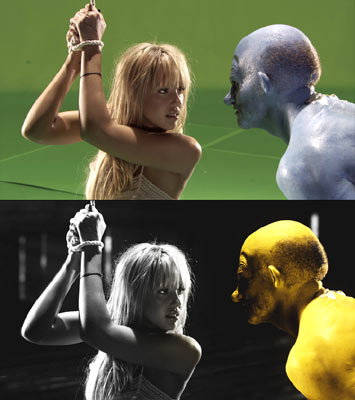
the evolution in filmmaking technologies, and in particular the
advent of digital compositing, has influenced the creation of
narratives in relation to the comic book movie genre. To better
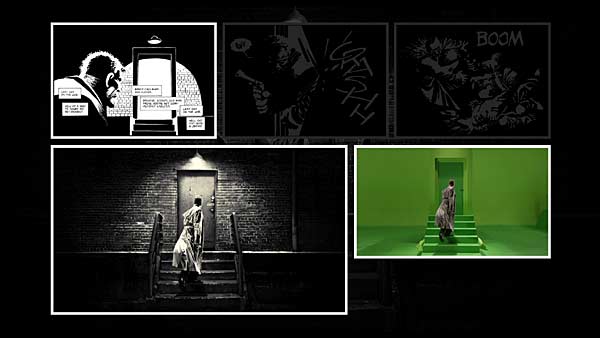
understand this evolution we will examine two major comic book movies
that, each one in its own way, have adopted an innovative and
original approach to the adaptation process: Richard Donner's
Superman:
The Movie
(1978) and Robert Rodriguez's Sin
City
(2005). For each one we will talk about the technologies involved in
the adaptation, production and post production processes, trying to
understand to what extent the availability of new technologies helped
the filmmakers in the creation of an original form of narrative. From
that analysis, we will then try to extrapolate the relationship
between technology and narrative, and understand which one is the
driving force that pushes the other towards new and previously
unexplored territories.