

What
Rodriguez's mastery in the use of digital technologies has allowed
him to do is to take the whole narrative from a medium (the comic
book) and transpose it, rather than adapt it in the conventional
sense, into another medium. As Ebert (2005) said, “this isn't an
adaptation of a comic book, it's like a comic book brought to life”.
The director himself explained it: “I wanted to bring Frank’s
vision to the screen as it was. I didn’t want to make Robert
Rodriguez’s Sin City. I wanted to make Frank Miller’s Sin City”
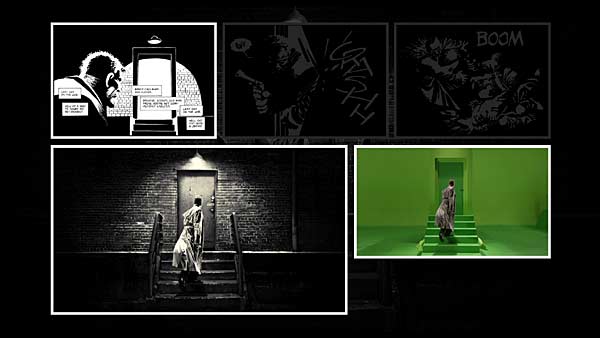
(Rodriguez, 2005). As an adaptation, the movie is a shot by shot
version of the comic book, in the sense that most of the shots are
framed in the exact same way as they show up in the book.

The
movie was shot entirely with digital cameras, and mostly in a digital
backlot environment. This means that, apart from the actors and a few
props, nothing of what the spectator sees on the screen is real, but
rather added later digitally. The degree of freedom that this kind of
workflow creates makes the making of a live action film more similar
to the creation of an animation film, where the only limit is
creativity since anything can be created and anything can happen with
no relevant impact on budget or time. The adoption of digital cameras
along with a digital post production workflow allows to cut
intermediary steps like printing the film, processing it, scanning
it, etc., and also speeds up the shooting process too since it is
possible to approach it with a “what you see is what you get”
attitude. For many years films and part of films have been shot
against green screens to later composite foreign elements into the
shots, but the digital cameras allow for real time composting
pre-visualization. This way the performance and the mise-en-scene can
be adjusted, if necessary, or better yet the environment can later be
adjusted to it.


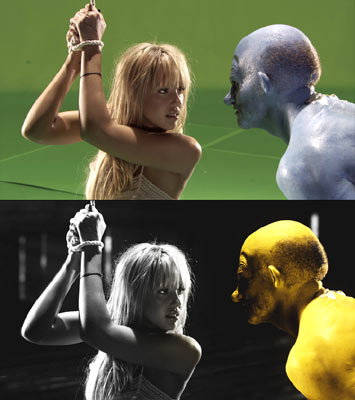
The colour palette in Sin City is, for most of the time, limited to a very small number of unsaturated, or low saturated, colours. The use of black and white, even in very contrasty forms, is not new in movies, but the way the digital technologies allowed for it to be implemented in this movie is rather unprecedented. In Miller's graphic novel, as in many other black and white comic books, most of the character and objects have an almost omnipresent edge quality in the way they're drawn. Far from being new, this technique has been often used in drawings to better separate the subjects from the backgrounds, to better isolate them, make them stand out and focusing the reader's attention to them. While in live motion picture a similar effect is usually achieved projecting a backlight to the rear of the subject in order to separate him from the background, this technique implies a lots of limitations in the camera movement and in the way the subject is forced to (or rendered unable to) interact with the background. On top of that, once an image is desaturated and it's contrast is increased, the amount of information that usually comes from colour and subtle changes in light in inevitably lost, making the contours of all the elements in the shot to blend together. Shooting the actors against a green screen with very little or no background allowed them to be isolated, then composited on top of a CG or separately shot background. This meant that the characters could undergo a separate lighting and colour correction process, which made it possible to wrap them in a light silhouette and make them better stand out from the background. This way yet another visual characteristic peculiar to the graphic novel is transposed into the motion picture thanks to the employment of technology.

Another
element of the original graphic novel, and a very peculiar one, is
the presence, from time to time, of small elements in full colour
inside the black and white shots. These elements, other than
contributing to the visual style of the comic book, also carry a
meaning or explain a characteristic of the character, the landscape
or the setting. Being the comic book part of the gore genre, elements
like the blood, the bandaids, cars and even weapons are made to stand
out as silhouettes or as the only item in full bright colour in the
picture. This kind of effect, once achievable only through long and
painful rotoscoping of the images, can now be achieved with selective
chroma key using coloured elements on the set.
 For
most of Sin City's
background elements, computer generated imagery (or CGI) was adopted.
Along with the use of green screen, this allowed for very few set
pieces to be built, lowering both production costs and time. But the
main reason why the narrative itself benefited from this solution is
to be found, once again, in the relationship between the movie and
the comic book and between the comic book and reality. A graphic
novel is, by its nature, a low level representation of reality. The
amount of details that a drawer can put into designing, sketching and
inking every single board is limited, and therefore the author
usually adopts a more subtle approach and paints a mediated version
of the reality, in which only the main tracts are conveyed. We could
arguably relate this principle to the Uncanny Valley hypothesis,
which stipulates that the closer we go to a reproduction of reality
without really reaching full detail depth the more unsettling the
resulting element will be for the human mind. This is why in many
occasions throughout the movie background and foreground elements,
along with props, were computer generated with an intentional low
detail level, so that in the context of the live comic book they
would look, if not real, right. Once
again, Rodriguez's knowledge of the technology allowed him and
co-director Miller to deeply commit to the source material. They bent
the tools to the task rather than being forced by a lack of tools to
bend and crack the source material in order to adapt it.
For
most of Sin City's
background elements, computer generated imagery (or CGI) was adopted.
Along with the use of green screen, this allowed for very few set
pieces to be built, lowering both production costs and time. But the
main reason why the narrative itself benefited from this solution is
to be found, once again, in the relationship between the movie and
the comic book and between the comic book and reality. A graphic
novel is, by its nature, a low level representation of reality. The
amount of details that a drawer can put into designing, sketching and
inking every single board is limited, and therefore the author
usually adopts a more subtle approach and paints a mediated version
of the reality, in which only the main tracts are conveyed. We could
arguably relate this principle to the Uncanny Valley hypothesis,
which stipulates that the closer we go to a reproduction of reality
without really reaching full detail depth the more unsettling the
resulting element will be for the human mind. This is why in many
occasions throughout the movie background and foreground elements,
along with props, were computer generated with an intentional low
detail level, so that in the context of the live comic book they
would look, if not real, right. Once
again, Rodriguez's knowledge of the technology allowed him and
co-director Miller to deeply commit to the source material. They bent
the tools to the task rather than being forced by a lack of tools to
bend and crack the source material in order to adapt it.
From
what has been said so far, the conclusion could be that a similar
result in the transposition of this graphic novel into film form
would not have been possible without a deep knowledge of what tools
the technology makes available to the filmmaker. To elaborate on
that, it seems that what was created with Sin City
was a total synergy between technology, creativity and narrative, an
unbreakable link that made the whole film simply work flawlessly in
this new, innovative art form. To better understand the unique
character of reciprocity between technology and narrative achieved in
this movie, we will now examine how two subsequent comic book
adaptations have managed to follow this remarkable piece of
filmmaking, buying into its methodology with very different results.

No comments:
Post a Comment