Monday, January 9, 2012

Introduction


What is the relationship between technology and narrative? Does technological advancement determine changes in the way we tell stories, or is it rather a need for a change that makes us seek new tools to tell them? Given that, both in science and art, humans have always created on top of what already existed, it could be argued that the evolution of bot technology and narrative is interconnected in a loop. Maybe the sudden availability of a certain technology determines a change in the way we approach a subject, a character or a story much like the invention of the telescope changed the way scientists approached astronomy. But at the same time, the very need to investigate, experiment and adopt new storytelling techniques can force us, or at the very least push us, to try and invent new tools, just like the invention of the car fulfilled a need for mass transportation, but then the car itself redefined the paradigm of mass transportation leading to new, different needs.


In this blog we will try to illustrate how the evolution in filmmaking technologies, and in particular the advent of digital compositing, has influenced the creation of narratives in relation to the comic book movie genre. To better understand this evolution we will examine two major comic book movies that, each one in its own way, have adopted an innovative and original approach to the adaptation process: Richard Donner's Superman: The Movie (1978) and Robert Rodriguez's Sin City (2005). For each one we will talk about the technologies involved in the adaptation, production and post production processes, trying to understand to what extent the availability of new technologies helped the filmmakers in the creation of an original form of narrative. From that analysis, we will then try to extrapolate the relationship between technology and narrative, and understand which one is the driving force that pushes the other towards new and previously unexplored territories.

Sunday, January 8, 2012

A bit of history


Some forms of comic book adaptation can be dated back as far as the early 1940, when short stories from successful comic strips like Batman, Captain America or Superman started to be made into movies for theatre screening. The technology and the production techniques employed in this early attempts, far from being cutting edge, only allowed for a dramatization that was very close to real life, both in its aesthetics and in its construction. Although a few special effects techniques had already been developed, like the matte painting, the rear projection, the double exposure, the roto-painting and even early version of blue screen, the costs, time consumption and expertise required made most of them unsuitable for this kind of small productions. Even when the first comic book adaptations in the form of feature length films started to appear in the mid 1960s, both the quantity and quality of tools devoted to the development of an original form of narrative were very poor, making it very difficult for most of those films to achieve a sense of wonder that would set the action on a higher than real level.


Although a few cases, like Stanley Kubrick's 2001: A Space Odyssey (1968) had tried to push the edge of the technology available to filmmakers, it wasn't until the late 1970s, with the advent of movies such as Star Wars (1977) that an understanding of how such advancements could greatly benefit the construction of narrative started taking place among filmmakers. The enormous success, in terms of both audience and critics, and the financial results that George Lucas's movie accomplished thanks to, among other things, the unprecedented quality and innovation in the visual effects pushed production companies to explore new ways to adopt the technologies. The revamp of the comic book movie (and in particular of the superhero sub-genre), was the perfect test subject for it.


Saturday, January 7, 2012

Superman: The Movie (1978)


Richard Donner's Superman: The Movie (1978) is considered by many to be the first example of the modern superhero feature film. Although the comic book had been around for more than 40 years, the attempts to adapt it to the moving image media had been limited. Apart from a few animated short stories in the late 1940, the first live action adaptation was the feature film Superman and the Mole Man (1951), immediately followed by a television series called Adventures of Superman (1951). In both, the most advanced visual effects were still realized with on camera tricks and devices like cables and springboards. It is anyway worth noticing that sometimes a rear projection technique was used, in which the background action was filmed separately and then projected on a screen in front of the camera with the actor performing in front of it. Although this allowed for the flying sequences to be achieved, the technique was neither new nor advanced.


When Donner's Superman was released, it tried to set a whole new standard for the global production value of superhero movies (and, by extent, comic book adaptations). Shot on a then very high budget of more than 55 million dollars, it was supposed be the next big visual effects film after Lucas's Star Wars. Thanks to the development of new techniques in the optical compositing process (the advent of digital manipulation was still many years away), the filmmaker could now enjoy a new degree of freedom in the adaptation process. While in the past his predecessors had to struggle with every single fantastic element, often being force to strip down the characters, the actions or even whole scenes because the technology didn't allow for a realistic representation, many of those could now be put back into the story and made to work in favour of the narrative. To no surprise the main advertisement line being used to promote the movie was in fact “you’ll believe a man can fly”. Such was the confidence in the quality of the visual effects that the movie was actually marketed with a strong emphasis on this aspect.


For the first time the shots of Superman flying were being shot against a blue screen, in a process that would later become the de facto standard for every kind of special effect. Although the technique was still in the early stages, the results achieved were still more realistic than the old rear projection technique in that the use of the blue screen allowed the character to be isolated and then optically superimposed on a background plate. Still, in comparison to earlier movies special effects Superman's flying sequences looked like a big setback on the quality standard levels. Misalignments in the film mattes (the actual cutout of the character), along with discrepancies in the colours between and inside shots, accounted for unrealistic images that would greatly decrease the spectators' immersion in the movie. The only true technological advancement was represented by the so called front projection technique, in which the background plate would actually be projected both on a background screen and on the subject standing between it and the camera, thus allowing for the plate to surround and wrap the character, better integrating him into the action.


And yet, Superman went on to great financial success and critical acclaim. Many praised Superman for its script, directing, acting, model and costume work, musical score. In the greater context of the comic book adaptation, the flaws in the special effects were generally disregarded as minor or inexistent, with some critic even saying that “they're as good in their way as any you've seen, and they come thick and fast”, while what was really being acclaimed was the miniature model work rather the the effects themselves.


Donner's movie can probably be accounted as an example of how an overconfidence in the possibilities of technology can actually make the storytellers bald enough to try and experiment new forms of narrative. Despite the fact that the movie does not work because of the special effects, but rather around them, the newly acquired possibility (or its perception) to create realistic and convincing sequences in which the protagonist makes use of his powers still benefited the construction of the narrative.

Friday, January 6, 2012

Sin City (2005)


In 2005 director Robert Rodriguez released the cinematic version of one of the most controversial graphic novels of the early 1990s: Frank Miller's Sin City. Considered by many a turning point in the comic book movie genre, Rodriguez's film is almost unique in the way it manages to bridge the two media (comic book and motion picture). The array of technologies involved in the production is extensive, since this is one of the first movies to have adopted an all digital workflow through all production phases. Like many other directors like George Lucas, James Cameron or Peter Jackson, Robert Rodriguez spent his whole (although relatively young) career in filmmaking constantly exploring the opportunities that technology gives to artists to explore new territories and push the boundaries of the imagination. While producing the Spy Kids children film series, he started to investigate the potentials in digital cinematography thanks to an earlier Sony prototype that George Lucas lent him. After some experimentation, Rodriguez was fascinated by the opportunities that a fully digital workflow would give to cut costs and production time while at the same time increasing the creative freedom of filmmakers.


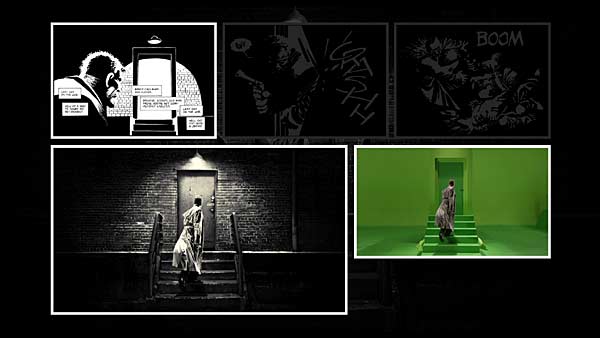
What Rodriguez's mastery in the use of digital technologies has allowed him to do is to take the whole narrative from a medium (the comic book) and transpose it, rather than adapt it in the conventional sense, into another medium. As Ebert (2005) said, “this isn't an adaptation of a comic book, it's like a comic book brought to life”. The director himself explained it: “I wanted to bring Frank’s vision to the screen as it was. I didn’t want to make Robert Rodriguez’s Sin City. I wanted to make Frank Miller’s Sin City” (Rodriguez, 2005). As an adaptation, the movie is a shot by shot version of the comic book, in the sense that most of the shots are framed in the exact same way as they show up in the book.


The movie was shot entirely with digital cameras, and mostly in a digital backlot environment. This means that, apart from the actors and a few props, nothing of what the spectator sees on the screen is real, but rather added later digitally. The degree of freedom that this kind of workflow creates makes the making of a live action film more similar to the creation of an animation film, where the only limit is creativity since anything can be created and anything can happen with no relevant impact on budget or time. The adoption of digital cameras along with a digital post production workflow allows to cut intermediary steps like printing the film, processing it, scanning it, etc., and also speeds up the shooting process too since it is possible to approach it with a “what you see is what you get” attitude. For many years films and part of films have been shot against green screens to later composite foreign elements into the shots, but the digital cameras allow for real time composting pre-visualization. This way the performance and the mise-en-scene can be adjusted, if necessary, or better yet the environment can later be adjusted to it.


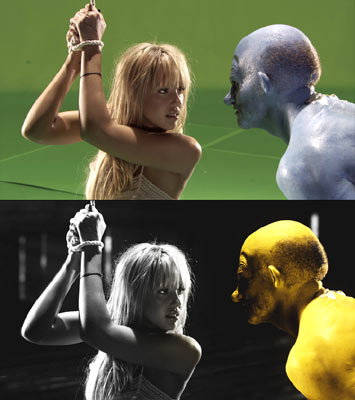
The colour palette in Sin City is, for most of the time, limited to a very small number of unsaturated, or low saturated, colours. The use of black and white, even in very contrasty forms, is not new in movies, but the way the digital technologies allowed for it to be implemented in this movie is rather unprecedented. In Miller's graphic novel, as in many other black and white comic books, most of the character and objects have an almost omnipresent edge quality in the way they're drawn. Far from being new, this technique has been often used in drawings to better separate the subjects from the backgrounds, to better isolate them, make them stand out and focusing the reader's attention to them. While in live motion picture a similar effect is usually achieved projecting a backlight to the rear of the subject in order to separate him from the background, this technique implies a lots of limitations in the camera movement and in the way the subject is forced to (or rendered unable to) interact with the background. On top of that, once an image is desaturated and it's contrast is increased, the amount of information that usually comes from colour and subtle changes in light in inevitably lost, making the contours of all the elements in the shot to blend together. Shooting the actors against a green screen with very little or no background allowed them to be isolated, then composited on top of a CG or separately shot background. This meant that the characters could undergo a separate lighting and colour correction process, which made it possible to wrap them in a light silhouette and make them better stand out from the background. This way yet another visual characteristic peculiar to the graphic novel is transposed into the motion picture thanks to the employment of technology.


Another element of the original graphic novel, and a very peculiar one, is the presence, from time to time, of small elements in full colour inside the black and white shots. These elements, other than contributing to the visual style of the comic book, also carry a meaning or explain a characteristic of the character, the landscape or the setting. Being the comic book part of the gore genre, elements like the blood, the bandaids, cars and even weapons are made to stand out as silhouettes or as the only item in full bright colour in the picture. This kind of effect, once achievable only through long and painful rotoscoping of the images, can now be achieved with selective chroma key using coloured elements on the set.


For most of Sin City's background elements, computer generated imagery (or CGI) was adopted. Along with the use of green screen, this allowed for very few set pieces to be built, lowering both production costs and time. But the main reason why the narrative itself benefited from this solution is to be found, once again, in the relationship between the movie and the comic book and between the comic book and reality. A graphic novel is, by its nature, a low level representation of reality. The amount of details that a drawer can put into designing, sketching and inking every single board is limited, and therefore the author usually adopts a more subtle approach and paints a mediated version of the reality, in which only the main tracts are conveyed. We could arguably relate this principle to the Uncanny Valley hypothesis, which stipulates that the closer we go to a reproduction of reality without really reaching full detail depth the more unsettling the resulting element will be for the human mind. This is why in many occasions throughout the movie background and foreground elements, along with props, were computer generated with an intentional low detail level, so that in the context of the live comic book they would look, if not real, right. Once again, Rodriguez's knowledge of the technology allowed him and co-director Miller to deeply commit to the source material. They bent the tools to the task rather than being forced by a lack of tools to bend and crack the source material in order to adapt it.


From what has been said so far, the conclusion could be that a similar result in the transposition of this graphic novel into film form would not have been possible without a deep knowledge of what tools the technology makes available to the filmmaker. To elaborate on that, it seems that what was created with Sin City was a total synergy between technology, creativity and narrative, an unbreakable link that made the whole film simply work flawlessly in this new, innovative art form. To better understand the unique character of reciprocity between technology and narrative achieved in this movie, we will now examine how two subsequent comic book adaptations have managed to follow this remarkable piece of filmmaking, buying into its methodology with very different results.


Thursday, January 5, 2012

Post Sin City (300 & The Spirit)


Even though Mabe (2005) commented that "there will be no reason for anyone to make a comic-book movie ever again. Miller and Rodriguez have pushed the form as far as it can possibly go", many other filmmakers have adapted graphic novels after Sin City was released. Among them, it is worthy to consider two, Zack Snyder's 300 (2007) and Frank Miller's The Spirit (2008), since both of them have borrowed a great deal of expertise from Rodriguez's experience, but with very different results.


Let's consider 300 first. Adapted once again from a Frank Miller's comic book series, it takes place in ancient greek during the Battle of Thermopylae. Unlike Sin City, which more or less in drawn from real world, 300 often crosses into the fantasy genre, with it's made up creatures, setups and environments, but nevertheless it's a shot-by-shot adaptation of the comic book. Although Snyder used many of the same techniques and technologies Rodriguez employed in Sin City (green screen shootings, digital matte painting) the style of 300's mise-en-scene has very little to do with it's predecessor. While keeping the visuals faithful to the comic book, Snyder brought his personal vision to the project, which resulted in a very different visual style. Examples of that range from the extensive camera movements to the use of CGI extras for the massive battle scenes to the extremely long variable speed shots where the action is at times sped up to be then greatly slowed down, an element that has since become a distinguished trait of Snyder's visual style. These stylish elements were made possible by an understanding and use of technologies such as virtual cameras in a digital environment and ultra high speed cameras (Wolff, 2007). Once again, this goes towards making the point that technology is a tool that, in the hands of a creative storyteller, can be used to convey a message in many different ways.


Let's now compare Sin City with Frank Miller's own The Spirit. Released just three years after Sin City, this movie is adapted from a 1940s comic strip by Will Eisner. Leaving the story aside, the film's visual heavily borrows from the visuals of Sin City, with its sharp silhouettes, a quasi black and white colour palette with a few elements kept in full, primary colours. The difference being that while Sin City was adapted from a comic book that was already drawn with these characteristics, the original The Spirit was a regular, full colour old style comic strip in the same style as the early Superman or Batman. It could be argued that Miller tried to apply Sin City's visual style to his own movie in an attempt to ride the popularity of Rodriguez's film among the hardcore comic book movie fan base. Or it could be that he just fell in love with the process while working himself as a co-director on Sin City. Anyway , unlike Rodriguez's and Snyder's movies, The Spirit performed poorly at the box office and was strongly criticized by many for its poorly constructed characters (Ebert, 2008) and its unconvincing narrative (Gleiberman, 2008). This could arguably seen as a further proof that it's not the technology that makes the narrative work, but rather a synergy between the two that comes from the storyteller's mastery of both. We have previously argued about how in Rodriguez's Sin City the technology is always working in a close connection with the narrative, and nothing is done for the mere sake of implementing a tool, but rather every element is interconnected like the sand grains in a sand castle. It would appear that in Miller's The Spirit most of the same technology are adopted, but rather than serving the purpose of telling the story, shaping the characters, immersing the spectator in the movie's reality they're just put to work, as it often happens in mainstream american movies, for the sole purpose of creating a visually pleasant film.


It could be argued that Mabe was exaggerating saying that the art form had been pushed as far as it could go. There's always room for experimentation and, since we always build upon other people's work, reaching the limit of creativity is almost impossible. What gets harder and harder is the process of going from what has been done to what could still be done.

Wednesday, January 4, 2012

Conclusions


To sum up, technology does influence narrative construction. If someone had been supposed to adapt Miller's comic books a few decades ago, there's no doubt the result would have been very different, as different as if someone tried to make a Superman movie in the 1930s. As quickly mentioned before, a comic book author, like a cartoonist, can enjoy a great level of freedom, the greatest after the one a writer can enjoy. It is so much easier to make things happen with words or with a drawing than to have to actually make them happen in order to film them, or at the very least look for the best compromise between cheating (special effects, miniatures, etcetera) and giving up. But with the advent of digital technologies, the advancements in CGI and compositing, the difference between a writer, a painter and a filmmaker is gradually shrinking. Many things that were absolutely impossible to achieve just a few years ago are not only becoming the norm, but the expertise level necessary to achieve them is decreasing, while quality is steady increasing. If it's true that whatever special effect or technology the big studios have today is going to be available to the desktop computer user in four years (Dean, 2003), this means that the tools that allow for the construction of new forms of narrative are going to be available to a bigger and bigger number of creative people, and this will probably also increase the speed at which narratives evolve.


In light of the examples presented in this blog, it can be argued that technology (and technological innovation) is a driving force in relation to narrative because it enriches the set of tools a creative person can use to tell a story. In this context, the driving element is represented by the technology itself, the knowledge and mastery of which can push the storyteller's imagination and craft towards new and previously unexplored horizons. However, an opposite case could be made with the analysis of films and filmmakers that, for the purposes and limitations of this research, could not be deeply examined. People like Kubrick, Lucas, Cameron and Jackson, other than taking advantage of what tools the technology makes available to them, have also gone the other way around. They conceived new forms of narrative and pushed the technology in order to create the tools they needed to make new kinds of storytelling possible. Whenever the technology needed to achieve the new forms of narrative they sought was simply too far away in the future, rather than subdue to the practical limitations and adjust the narrative to adapt to it, they simply waited for the technology to become sufficiently sophisticated to fulfil their needs.
If we consider both aspects of the process, we can argue that the relationship between technology and narrative is truly circular, with one pushing the other forward and then being pushed forward on its own, in an increasingly faster and faster attempt to keep narrative constantly fresh and original and technology constantly evolving.

Tuesday, January 3, 2012

Bibliography


Dean, M.W., 2003. 30 Dollars Film School. Boston, USA: Premier Press.


Ebert, R., 31 March 2005. Sin City. Roger Ebert. Available from: http://rogerebert.suntimes.com/apps/pbcs.dll/article?AID=/20050331/REVIEWS/50322001 [Accessed 16/12/2011].

Rodriguez, R., 2005. In: Rowe, R., 2005. Digital Desperado. Robert Rodriguez's HD Noir. Editors Guild Magazine, Vol. 26 N. 3. Available from: https://www.editorsguild.com/Magazine.cfm?ArticleID=85 [Accessed 04/01/2012].

Mabe, C., 2005. In: Chauncey Mabe. Rotten Tomatoes. Available from: http://www.rottentomatoes.com/critic/chauncey-mabe/ [Accessed 02/01/2012].

Gleiberman, O., 2008. The Spirit. EW.com Entertainment Weekly. Available from: http://www.ew.com/ew/article/0,,20248903,00.html [Accessed 16/12/2011].

Wolff, E., 1 March 2007. Step by Step: 300. DigitalContentProducer.com. Available from: http://digitalcontentproducer.com/mil/features/video_step_step/ [Accessed 12/12/2011].


Superman: The Movie, 1978. Film. Directed by Richard Donner. UK-USA: Dovemead, Film Export A.G., International Film Productions.

Sin City, 2005. Film. Directed by Frank Miller, Robert Rodriguez. USA: Troublemaker Studios.

2001: A Space Odyssey, 1968. Film. Directed by Stanley Kubrick. UK: MGM.

Star Wars, 1977. Film. Directed by George Lucas. USA: Lucasfilm.

Superman and the Mole Men, 1951. Film. Directed by Lee Sholem. USA: Lippert Pictures Inc.

Adventures of Superman, 1952. TV series. Created by Jerry Siegel, Joe Shuster. USA: ABC.

Spy Kids, 2001. Film franchise. Created by Robert Rodriguez. USA: Troublemaker Studios.

300, 2007. Film. Directed by Zak Snyder. USA: Legendary Pictures, Virtual Studios, Cruel and Unusual Films.

The Sprit, 2008. Film. Directed by Frank Miller. USA: Lionsgate, Odd Lot Entertainment.